T. Marshall

Is your prior criminal record holding you back from being the best that you can be? If so, T. Marshall can help you get a second chance at life.
Do you have a Pennsylvania criminal conviction for decades old bad behavior? Are you a reformed law-abiding citizen who wants a second chance at life? I have good news for you. Second chances are possible in Pennsylvania. Though extremely rare, pardons and commutations are available to certain people who can demonstrate that they have rehabilitated themselves and are worthy of a second chance.
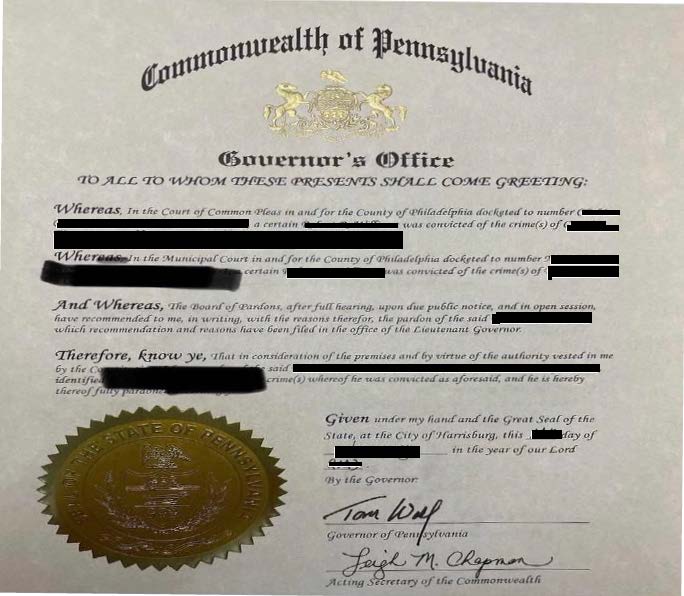
What is a pardon? A pardon is clemency, i.e., forgiveness, granted by the governor with the advice and consent of the Board of Pardons.
What does a pardon do? In the Pennsylvania, a pardon completely nullifies a criminal conviction and restores all rights, such as the rights to bear arms and to hold public office, among others, that previously were lost due to a prior conviction.
The Pennsylvania Supreme Court explained the power of a pardon as follows:
"[T]he exercise of the sovereign’s prerogative of mercy. It completely frees the offender from the control of the state. It not only exempts him from further punishment but relieves him from all the legal disabilities resulting from his conviction. It blots out the very existence of his guilt, so that, in the eye of the law, he is thereafter as innocent as if he had never committed the offense." Commonwealth v. Sutley, 378 A.2d 780 (Pa. 1977).
What is a commutation? A commutation is a form of clemency granted by the governor. A commutation is different from a pardon. Unlike a pardon that effectively erases the prior conviction as if the conviction had never occurred, a commutation only reduces one’s sentence or fine imposed because of the conviction. Typical candidates for commutations are persons serving lengthy prison sentences and seek a sentence reduction.
When should you apply for clemency? It depends upon the circumstances of your case and how long ago it occurred. For instance, someone with a violent crime should wait at least ten years from the completion of their sentence before applying for clemency so sufficient time has passed to demonstrate that good behavior is not temporary but is permanent. Also, if you are currently challenging your conviction and claiming your innocence in the legal system, it is best that you complete your court challenges prior to applying for clemency. To get clemency in Pennsylvania, you must accept responsibility for your role in the prior crime.
Give us a call to speak with expert pardon counsel who knows the ins and out of the pardon process and who can give you in depth advice for your unique situation.
Give us a call: (215) 609-4888